Etna’s June 2nd, 2025 Eruption: A Spectacular Display of Nature
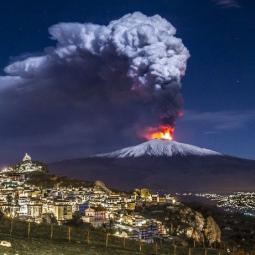
Earlier today, June 2nd, 2025, Mount Etna erupted once again, offering a striking but scientifically expected show of volcanic activity

A pyroclastic flow on Mt. Etna
Earlier today, June 2nd, 2025, Mount Etna erupted once again, offering a striking but scientifically expected show of volcanic activity. The eruption originated from the Southeast Crater, producing a tall eruptive column visible across much of eastern Sicily and triggering a partial collapse of the northern crater wall. This event generated a pyroclastic flow into the uninhabited Valle del Bove.
Despite its visual impact, local authorities—including the mayor of Catania—have confirmed that the situation remains under control, with no significant threats to public safety. While the INGV (National Institute of Geophysics and Volcanology) has issued a red alert for aviation, Catania Airport continues to operate normally.
Why Etna Is a Safe Volcano
Etna is one of the most active volcanoes in the world, but it is also among the most studied and monitored. Its eruptions are typically strombolian in nature—characterized by mild to moderate explosions and slow-moving lava flows. This behavior is closely tied to the composition of its magma.
Etna's magma is basaltic, meaning it contains a relatively low percentage of silica (SiO₂). This makes it much more fluid and allows volcanic gases to escape gradually, reducing pressure buildup. As a result, Etna's eruptions are rarely explosive in a catastrophic sense, and are instead predictable and manageable, especially given the sophisticated monitoring systems in place.
A Comparison with Mount St. Helens: Why Not All Volcanoes Behave Like Etna
To better understand Etna's behavior, it's helpful to compare it to Mount St. Helens, a stratovolcano located in Washington State, USA. On May 18, 1980, Mount St. Helens erupted catastrophically after a magnitude 5.1 earthquake triggered the collapse of its northern flank. This collapse instantly released the pressure of gas-rich magma beneath the surface, leading to one of the most violent eruptions in U.S. history.
Unlike Etna’s basaltic lava, Mount St. Helens' magma was dacitic, containing a much higher silica content (around 65%). This made it significantly more viscous, preventing gases from escaping. The trapped gases eventually led to an explosive lateral blast, flattening 600 square kilometers of forest and killing 57 people. This type of eruption is typical of dome-building volcanoes, which are inherently more dangerous due to the potential for sudden, violent pressure release.
Conclusion: Etna Is No Mount St. Helens
While today’s eruption may seem dramatic, Etna’s geological nature and eruptive behavior set it apart from high-silica, dome-type volcanoes like Mount St. Helens. Etna’s fluid magma allows for relatively gentle eruptions, giving scientists and civil protection agencies time to respond effectively. Events like today's are part of the volcano’s normal activity cycle and, though visually impressive, do not pose the same kind of threat as more explosive volcanoes.
Etna is not only a natural laboratory for volcanologists but also a living example of how science, preparedness, and geography combine to make an active volcano both fascinating and fundamentally safe for nearby populations.